
The Film Mixer’s Reference is a four-volume series on the tools I use every day on the mix stage. Each booklet takes one tool, and goes as deep as it should. I’ve written it in a way that seasoned mixers as well as students can make use of this.
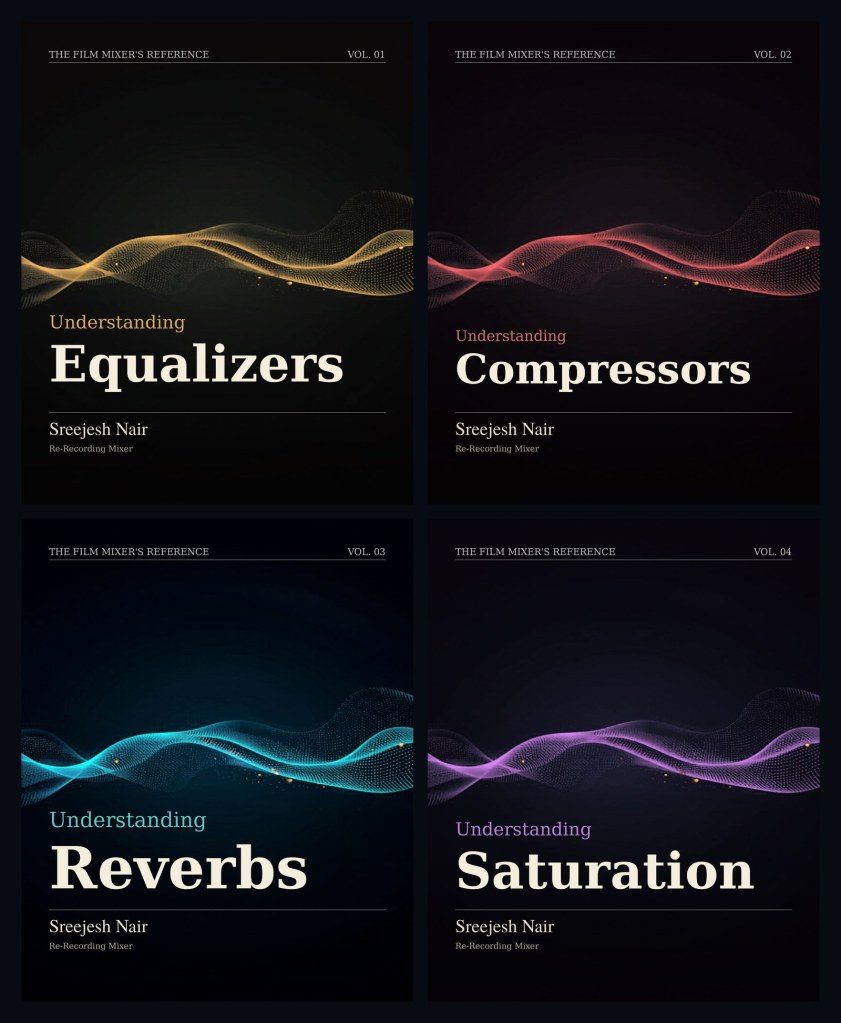
If you read this blog, you probably know how these books are written. Over the past few notes, I’ve published long posts here on equalizers, compressors, reverbs, and saturation. The booklets are those posts taken further. More history, more diagrams, more of the working ideas that come from my experience of years on the mix stage. These are written so that they read intuitively rather than academically and we get to understand the beauty behind this as audio engineers.
We start at the fundamentals, and go through the actual physics of what is happening. Then look at how the tool behaves and what the controls do when you turn them. Then into the analog circuits, because that is where the character of these tools comes from. And then into the plugins, how those same circuits get modelled in the software we reach for every day. Its the whole journey end to end. That is kind of the thing I always wanted to read myself.
Now, these are not textbooks. I don’t write like a textbook. They are reference books in the working sense. You read them in the order that matters to you. You come back to a chapter when a question comes up on the floor. The maths shows up only where it actually changes a decision you would make. The history shows up because the history is the design philosophy.
So, here they are. Each booklet is $15. The complete set of four is $40.
Vol. 01: Understanding Equalizers
What an equalizer is really doing when you move a band. Filter topology, phase response, the difference between minimum-phase and linear-phase, and why the same EQ move sounds different on a Neve than on a Pultec. The Baxandall shelf, the Linkwitz-Riley crossover, the parametric, the graphic, the dynamic EQ, the match EQ. Each one explained from the inside out.
137 pages. 10 chapters. $15.
Vol. 02: Understanding Compressors
Gain reduction, knee, attack, release, sidechain. What each control actually does to the signal. VCA, FET, optical, vari-mu. The 1176, the LA-2A, the Fairchild 670, the SSL bus compressor, the dbx 160. Where each one came from and where it shines on the floor. The dynamics decisions that hold a reel together rather than squash it.
125 pages. 11 chapters. $15.
Vol. 03: Understanding Reverbs
Plates, chambers, springs, algorithms. How each one works, where it came from, and how to pick one for a scene. The hardware lineage from EMT to Lexicon to Bricasti to Valhalla. Early reflections and late tail, predelay, modulation, ducking, tail suppression. The working judgements that separate a mix that breathes from one that feels stuck behind glass.
119 pages. 15 chapters. $15.
Vol. 04: Understanding Saturation and Distortion
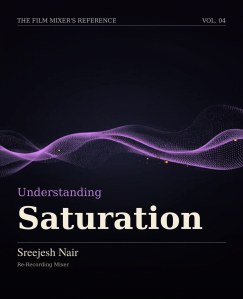
Tape, tubes, transformers, transistors, code. What each kind of saturation actually does to a signal. Why some of it feels musical and some of it just sounds broken. Anti-aliasing in software saturators, oversampling, the difference between modelling a circuit and approximating a curve. How to reach for the right colour at the right moment in a mix.
138 pages. 12 chapters. $15.
The Complete Set: All Four Volumes
Buying the four separately works out to $60. The complete set is $40. All four PDFs delivered together as a single download.
This is the way I would recommend reading them. The four tools talk to each other. The EQ moves you make change how a compressor responds. The reverb you reach for is shaped by the saturation in your bus path. Reading the series together gives you that whole picture.
A note on what these are
You see, the way I see it, a mixer who understands what a tool is doing makes better decisions. Faster, calmer, and with fewer regrets. That is the entire reason these books exist. They are not surveys. I do not try to cover every plugin on the market. Each book takes one tool and goes deep.
So, if you have read the blog posts and wanted more, this is where the more lives.
Questions or feedback? Write to theartoffilmmixing@gmail.com.
Happy Mixing!
-FM

